
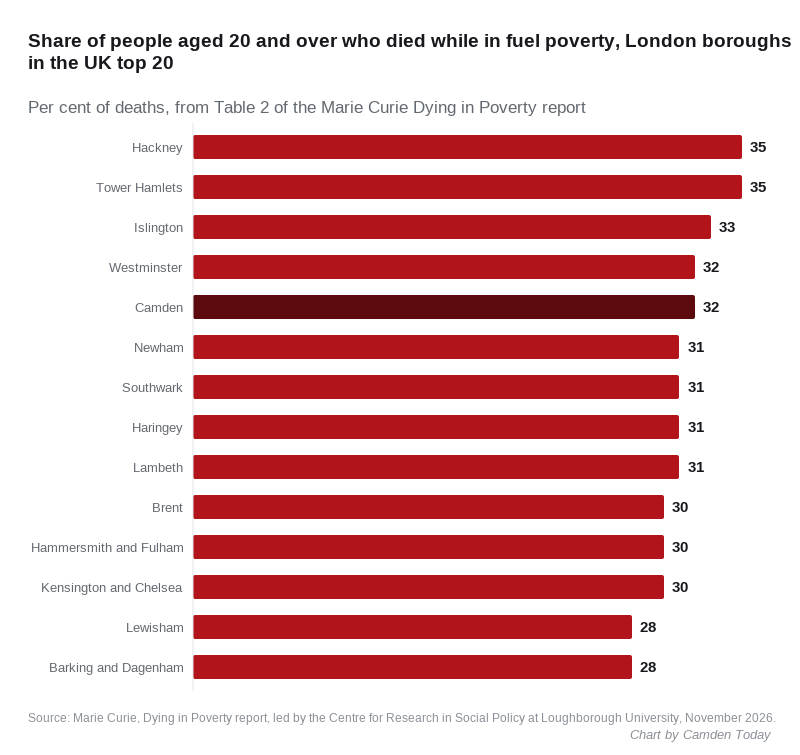
Marie Curie's Dying in Poverty report puts Camden among the 20 UK areas where the most people died in fuel poverty: 32% of those aged 20 and over who died.
In Camden, 32% of people aged 20 and over who died were living in fuel poverty, according to new research from the end of life charity Marie Curie. The figure for Camden is 32%, the same as Westminster.
Overview
- Camden: 32% of people aged 20 and over who died were in fuel poverty.
- Higher: only Hackney and Tower Hamlets (35%), Belfast (34%) and Islington (33%).
- London: 14 boroughs are in the UK’s top 20 for fuel poverty at the end of life, and 12 in the top 20 for poverty.
- The report: Dying in Poverty, led by the Centre for Research in Social Policy at Loughborough University.
- Help: the free Marie Curie Support Line is on 0800 090 2309.
Camden against the rest of London
The Dying in Poverty report found that London had the highest rate of poverty among people who died of any UK region, at 20%, or one in five.
Its fuel poverty table lists the 20 UK local authorities with the highest share of people aged 20 and over who died in fuel poverty. Fourteen of them are London boroughs. Camden sits alongside Westminster and Derry City and Strabane at 32%, with Newham, Southwark, Haringey and Lambeth at 31%, and Brent, Hammersmith and Fulham and Kensington and Chelsea at 30%.
On the wider measure of poverty, Camden is not in the UK top 20, but three of its neighbours are. Westminster and Haringey recorded 24% and Islington 23%, against 30% in Tower Hamlets and 28% in Newham, the highest in the country.
Who is most likely to die in poverty
Across the UK, the report found that 28% of working age people die in poverty, compared with 15% of people over pension age. Marie Curie says working age people who are dying are often forced to give up work as the cost of running medical equipment rises, and that working age couples where one partner is terminally ill are likely to receive at least £500 a month less in benefits than a couple of pension age.
The figures by ethnic group show 36% of Black people who died were living in poverty, compared with 28% of Asian people, 32% of people from other ethnic groups and 14% of white people.
Since 2023, the charity says, 310,000 people in the UK have died in poverty and 394,000 in fuel poverty: on average, one death in poverty every five minutes and one in fuel poverty every four minutes over the past three years.
‘A punch in my stomach’
Simona, 48, from Enfield, struggled to keep the heating on and pay for medical equipment after her husband David was diagnosed with a stage four glioblastoma. He died at 47 in 2024, six months after the diagnosis.
“Families shouldn’t have to worry about whether they can afford to power a stairlift or not. There should be an allowance for electricity for families affected by terminal illness,” she said.
“The other day, I was taking out the electric blanket, the one that my husband David used during chemotherapy to help him cope with the shivers and keep his body warm when his temperature dropped. Instinctively, I felt a punch in my stomach as I thought about how much it would cost to plug it in. Even now, I find myself feeling those same feelings of anxiety and financial pressure.
“David paid his taxes his whole life. It makes me really sad and frustrated to think that all this money will get wasted. He could have been more financially supported if he’d been able to access his state pension early. It would have made a big difference to us.”
What Marie Curie wants
The charity says the government should have gone further than the £100 energy payment for certain households announced in the Chancellor’s budget. It is calling for an energy social tariff and for the working-age benefits system to give terminally ill people greater protection against poverty.
Matthew Reed, chief executive of Marie Curie, said: “The idea that every five minutes someone dies having spent their final moments not being able to afford to keep the heating on or get food on the table is deeply troubling.
“No one should have to spend their final days worrying about money, but for every single person across the UK right now a terminal diagnosis will mean they are more likely to face poverty.
“There is no single fix for poverty, including fuel poverty, at the end of life, but action is urgently needed. Terminally ill people and their families are counting on it.”
Dr Juliet Stone, senior research fellow and associate director at the Centre for Research in Social Policy at Loughborough University, said: “Our latest analysis shows that poverty and fuel poverty at the end of life remain a major challenge across the UK, with tens of thousands of people dying in hardship every year.
“While the UK Government’s stated commitment to tackling the pressures of a rising cost of living is welcome, ‘small fixes’ such as the £100 Household Energy Payment only scrape the surface of what is needed. People with terminal illness cannot wait for incremental changes. They need support now, to ensure that they have the financial security to die with dignity.”
Support and the petition
Anyone living with a terminal illness, or affected by dying, death and bereavement, can call the free Marie Curie Support Line on 0800 090 2309 or visit mariecurie.org.uk.
The charity’s Cost of Dying campaign and petition for better financial support are at mariecurie.org.uk/campaigns, and its petition for an energy social tariff for terminally ill people is at mariecurie.org.uk/energy-petition.
Source: Marie Curie.
Have your say