
Camden schools took 73.7% of GCSE entries to grade 4 or above, against 67% nationally. Nine schools' results, the benchmark that flatters, and the appeal date.
Camden schools took 73.7 per cent of their GCSE entries to grade 4 or above this summer, and 29 per cent to grade 7 or above, according to provisional figures published by Camden Council the day after Year 11 collected their results on Thursday 20 August.
The council sets both numbers against a national average: 67 per cent at grade 4 and above, and 21.8 per cent at grade 7 and above. Those two figures are correct. They come from Ofqual’s official statistics for summer 2026, which record 67.0 per cent and 21.8 per cent across all 5,720,045 GCSE results issued in England.
But England is not the benchmark that tells a Camden parent much, and neither is the all-ages figure. On both counts, Camden’s results look rather different once you use a comparison that matches what its schools actually do.
The benchmark question
Ofqual publishes its GCSE outcomes two ways, and the gap between them is wide.
Table 19a covers every result issued in England, at any age. Table 19b covers only results issued to 16-year-olds, which is what a secondary school’s Year 11 cohort is. Stripping out the older candidates lifts England’s grade 4 rate from 67.0 per cent to 70.7 per cent.
The reason is in the same publication. Ofqual records that 265,825 students, a quarter of everyone who got a GCSE result this year, sat exactly one. Among 16-year-olds, only 1.4 per cent did. Those single-entry candidates are overwhelmingly resitting English or maths at a college, and the results table shows what that does to an average: further education establishments recorded 17.6 per cent at grade 4 and above, and sixth form colleges 32.2 per cent. They are not failing institutions. They are doing a different job, with students who did not reach grade 4 the first time.
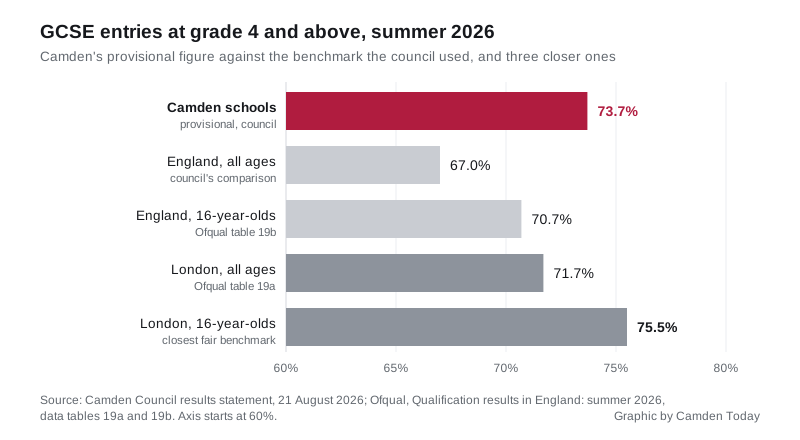
Region matters too. London was the strongest region in England, at 71.7 per cent grade 4 and above across all ages and 75.5 per cent among 16-year-olds.
Set Camden’s 73.7 per cent against each of those in turn:
- England, all ages: 67.0 per cent. Camden is 6.7 points ahead. This is the council’s comparison.
- England, 16-year-olds only: 70.7 per cent. Camden is 3.0 points ahead.
- London, all ages: 71.7 per cent. Camden is 2.0 points ahead.
- London, 16-year-olds only: 75.5 per cent. Camden is 1.8 points behind.
The same pattern holds at the top end. Camden’s 29 per cent at grade 7 and above is 7.2 points clear of the England all-ages figure, but only 0.4 points clear of London’s 28.6 per cent, and 1.2 points behind London’s 16-year-old rate of 30.2 per cent.
None of this makes Camden’s results bad. A borough performing at roughly the London average is performing well above the country. It does mean the headline gap is smaller than the press release implies, and the council does not state which basis its own 73.7 per cent uses. It says “Camden schools’ GCSE exam entries”, which points to school entries rather than college resits, so the London 16-year-old line is the closest fair comparison available.
One figure cannot be checked at all. The council reports 7.2 per cent of Camden entries at grade 9 against a national average of 5 per cent. Ofqual’s published data tables carry no England-wide percentage of results at grade 9, only grade 7 and above and grade 4 and above. That comparator is the council’s, and there is no official table to set it against.
What the schools reported
Nine Camden schools shared results through the council. Several published figures for English and maths together, which is the measure that decides whether a student has to keep studying those subjects after 16.
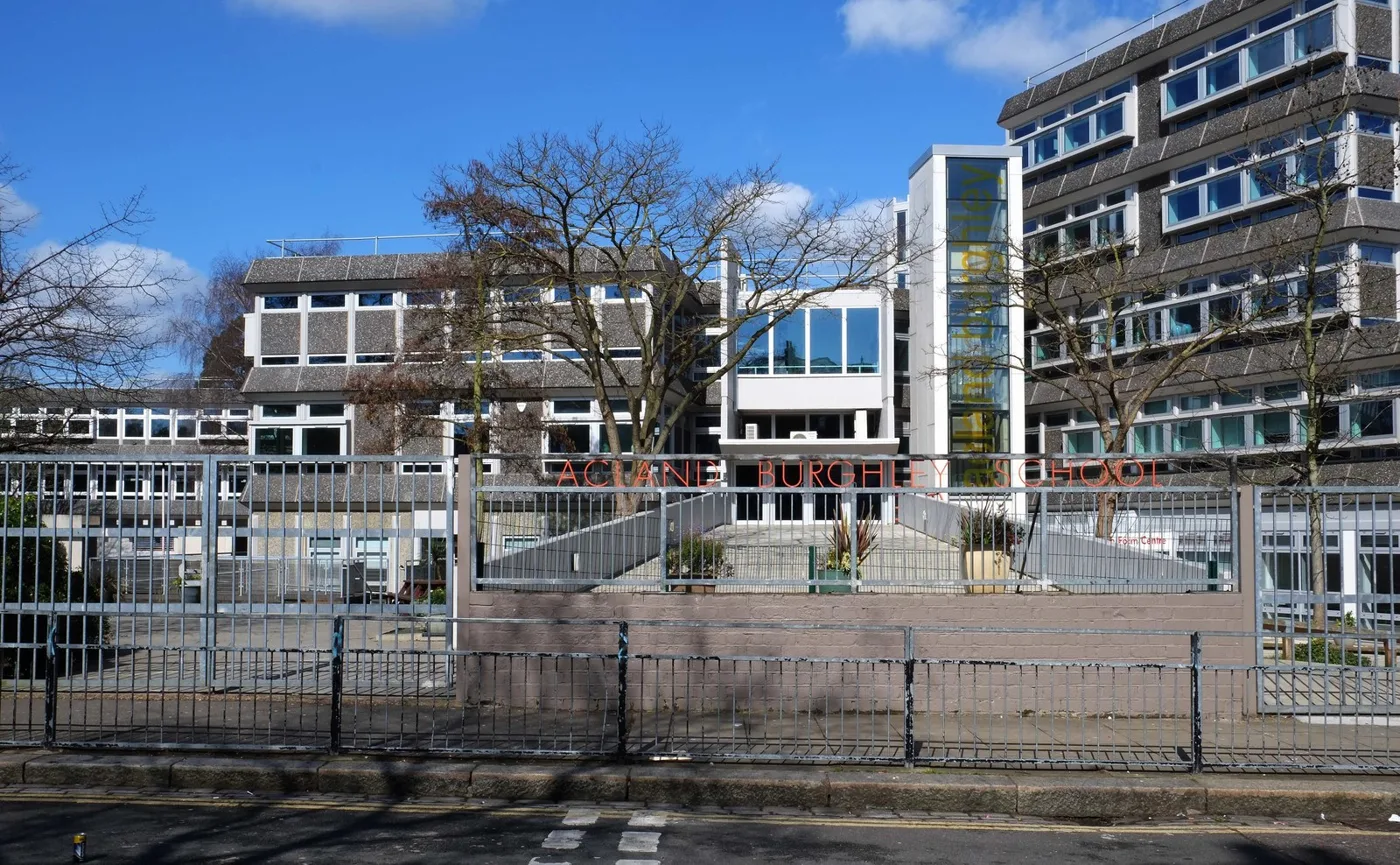
- Acland Burghley School, Tufnell Park: 76 per cent at grade 4 or above in both English and maths, and 45 per cent at grade 7 or above in maths. Headteacher Nicholas John called them “Acland Burghley’s best GCSE results since curriculum reform in 2017, by a significant margin”.
- Parliament Hill School, Highgate Road: 47 per cent of all grades at 9 to 7, and 85 per cent of students at grade 4 or above in both English and maths.
- William Ellis School, Highgate Road: 70 per cent of boys at grades 4 to 9 in both English and maths, with 54 per cent reaching at least grade 5 in both.
- La Sainte Union Catholic School, Highgate Road: 92.3 per cent at grades 9 to 4 in English literature and 87 per cent in English language. Chemistry, biology and physics all recorded 100 per cent pass rates. Almost 90 per cent of students achieved five or more GCSE passes.
- Maria Fidelis Catholic School, Somers Town: its best set of results since 2017. Headteacher Mark Anthony credited after-school and weekend classes that ran from the start of the year.
Regent High School, Haverstock School, Hampstead School and UCL Academy reported individual achievements rather than school-wide percentages.
Two Camden students, one at Maria Fidelis and one at UCL Academy, were awarded grade 9 in all ten of their GCSEs. For scale, Ofqual counted 1,375 students in the whole of England who took seven or more GCSEs and got grade 9 in every one, 0.2 per cent of that group.
A note on comparing schools from these numbers: you largely cannot. Each school has chosen its own measure, some report grades and others report students, and the five range from a boys’ school (William Ellis) to two girls’ schools (Parliament Hill and La Sainte Union) to two mixed ones. The like-for-like comparison arrives with the validated performance tables later this year, which the council expects to be at or above the national average.
What it means for you
If a grade looks wrong, the deadline is 24 September. Two services are open, and JCQ sets both closing dates at 24 September 2026:
- a clerical re-check, confirming the marks were added up and recorded correctly, returned within 10 calendar days
- a review of marking, where a senior examiner looks at the marking itself, returned within 20 calendar days
Three things families regularly get wrong. The request goes through the school’s exams officer, not the student or parent, and written consent from the candidate is required. There is no grade protection, so a grade can go down as well as up. And the priority service that closed on 20 August covered A-levels, AS and Level 3 vocational qualifications only, never GCSEs.
If English or maths came in below grade 4, the resit series is in November. Pearson Edexcel’s final November 2026 timetable sets the dates, all morning sittings:
- English Language paper 1: Tuesday 3 November
- Maths paper 1, non-calculator: Wednesday 4 November
- English Language paper 2: Thursday 5 November
- Maths paper 2, calculator: Friday 6 November
- Maths paper 3, calculator: Monday 9 November
Entries are made by the school or college, so the conversation to have this month is with the sixth form or college a student is joining in September.
If the next step is still undecided, the council points to the Camden Rise careers and opportunities service and Camden Learning’s Next Steps Post-16 advice for sixth form, college and apprenticeship routes.
Camden’s own A-level, T-level and vocational results were published a week earlier, and included a 100 per cent pass rate for the borough’s first T-level cohort.
Sources
- Camden students celebrate GCSE results day 2026, Camden Council, 21 August 2026, for the borough figures, the school results and the quotes.
- Qualification results in England: summer 2026, Ofqual, updated 20 August 2026. Data tables 16, 18, 19a, 19b and 20 for the national and regional comparisons.
- Post-results services, JCQ, for the review and re-check deadlines.
- GCSE November 2026 examination timetable, final, Pearson Edexcel, for the resit dates.
Have your say