
Camden's average A-level point score rose to 35.9 and its first T-level cohort passed at 100 per cent. The figures, the schools, and where to get advice now.
Camden’s average point score per A-level entry rose to 35.9 this summer, up from 35.4 in 2025, and 98.1 per cent of the borough’s A-level entries were awarded grades A* to E, according to figures published by Camden Council after Year 13 students collected their results on Wednesday 13 August.
The more unusual number is in technical education. This summer was the first time students in Camden schools finished T-levels, the two-year technical qualification introduced to sit alongside A-levels, and that first cohort recorded a 100 per cent pass rate. The council puts the national pass rate at 93 per cent.
The first T-level cohort
T-level students at Acland Burghley School, Haverstock School and Maria Fidelis School made up Camden’s first group to complete the qualification. The council reports that 92 per cent achieved a Distinction or Merit, against a national average it gives as 68.9 per cent.
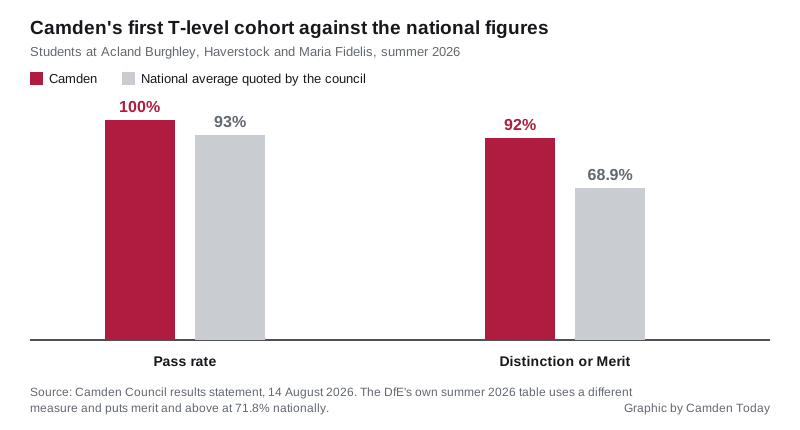
One note of caution on that second comparison, because the national T-level picture is measured in more than one way. The Department for Education’s own published results table for summer 2026 records 71.8 per cent of students expected to complete a T-level at merit or above on the occupational specialism, with 18.3 per cent at distinction. That is a different measure from the one in the council’s statement, covering a different group of students, so the two figures are not interchangeable. Camden’s own result stands either way; the size of the gap depends on which national number you set it against.
The council describes those grades as equivalent to achieving AAA to BBB at A-level.
What the borough figures do and do not tell you
The average point score per entry is the measure the council leads on, and it is the fairer one for comparing a whole borough year to year, because it does not move simply because more or fewer students entered. Camden’s rise from 35.4 to 35.9 is real but modest.
The 98.1 per cent A* to E figure is a pass rate, not a measure of high grades. Nationally, 28.3 per cent of all A-level results were at grade A or above and 78.1 per cent at C or above, across 835,950 results issued to 320,505 students. London was the strongest region in England on both counts, at 32.7 per cent grade A and above and 80.5 per cent at C and above, ahead of the South East on 31.5 per cent and well ahead of the North East on 23.1 per cent.
Camden has not published a borough-wide A or A* rate, so the borough cannot be placed directly against that London figure. The one Camden number of that kind in the public statement comes from the LaSWAP sixth form consortium.
Vocational qualifications, taken alongside and instead of A-levels, also moved up: the average point score per entry was 31.7, against 30.0 in 2025.
LaSWAP and the individual schools
Nicholas John, headteacher of Acland Burghley School, speaking for the LaSWAP consortium, said this was “the biggest set of results, as well as the best set of results since curriculum reform for the consortium”, reporting that 25 per cent of grades awarded were A or A* and 82 per cent were C and above. He added that the first cohort to complete the Media, Broadcast and Production T-level at Acland Burghley saw over 80 per cent achieve a merit or distinction.
LaSWAP is the shared sixth form run by La Sainte Union Catholic School, Acland Burghley School, William Ellis School and Parliament Hill School, which is why one set of results covers four schools.
Joe Edwards, interim head of school at Haverstock, said the results and destinations were “testament to their hard work and dedication, and those of their teachers”. Kateryna Law, headteacher of Camden School for Girls, said the school had “achieved another exceptional set of A-level results this year”.
Hampstead School, UCL Academy and Maria Fidelis School were also named in the council’s statement. Individual school-level results tables are not published on results day; the Department for Education releases verified school and college performance data later in the academic year, so any single school’s headline claim this week is its own figure rather than a checked national statistic.
What it means for you
If you want a paper reviewed, the urgent deadline is Thursday 20 August. The Joint Council for Qualifications post-results booklet for summer 2026 sets 20 August as the date by which awarding bodies must receive requests for a Priority Service 2 review of marking for A-levels, T-levels and level 3 vocational qualifications. That is the fast route, and it exists for students whose university place depends on the outcome. The standard deadline for a review of marking is 24 September 2026, with the review completed within 20 calendar days.
Two things about that process are worth knowing before you ask. You cannot request it yourself: the request goes in through your school or college, and the centre must hold your written consent on file, given after results were published. And a review can lower your grade as well as raise it. The JCQ rules state that centres must tell candidates their “marks and subject grades could go down as well as up” before submitting. Reviewers do not re-mark the paper; they check that the mark scheme was applied correctly and correct errors.
If you are looking at work or training instead, Camden Council points students to its Camden Rise service for advice on university, apprenticeships and wellbeing, and to its Opportunity Centres at the London AI Campus and the Euston Skills Centre. Care leavers are supported through the council’s Virtual School.
If you are travelling to a new college or an apprenticeship in September, check what your journey will actually cost before you commit: our guide to Camden tube times and fares sets out the zone boundaries and the student discounts that apply.
If you did not get the grades you needed, UCAS Clearing is open, and you do not have to settle it today. Speak to your sixth form or college before accepting anything: they can see your full profile and will know which courses in London are still taking students.
GCSE results follow on Thursday 20 August, the same date the JCQ booklet gives for the issue of GCSE results, and the Department for Education’s national results page is due to be updated that day with the level 1 and 2 figures.
Have your say