
Camden's own register logs 30,333 council trees worth £1bn, with 172 marked for felling. Firms bidding for council contracts can now pay for new planting.
Camden has signed a contract that lets companies bidding for council work pay for trees to be planted and looked after across the borough, and says it is the first council in the UK to do it. The announcement, made on 11 August, names Carbon Heroes, a London-based urban nature platform, as the contractor that will price and track what suppliers put in.
What the announcement does not set out is the size of the thing being topped up. Camden publishes its working tree register as open data, and it is unusually detailed. Pulled on 17 August, it holds 28,075 records covering 30,333 council-owned trees, and it puts a price on nearly every one of them.
The borough’s trees are on the books at just over £1 billion
Add up the register’s valuation column and Camden’s council-owned trees come to £1,003,777,412.
That figure is not a guess. Each tree carries a Capital Asset Value for Amenity Trees, the method tree officers use to price a tree as a public asset the way a council would price a building, based on its size, condition, position and how many people it serves. It is the number that gets quoted when a tree is lost to a development or a vehicle strike.
The single most valuable trees are the big old ones on the main squares. One of the London planes recorded on Brunswick Square in Bloomsbury is valued on its own at £795,247, and logged as holding 7.5 tonnes of carbon.
The same register puts the whole council-owned stock at 11,699 tonnes of stored carbon, taking in a further 196 tonnes a year, and stripping 285 kilograms of pollution a year out of the air.
Where the 30,333 trees actually are
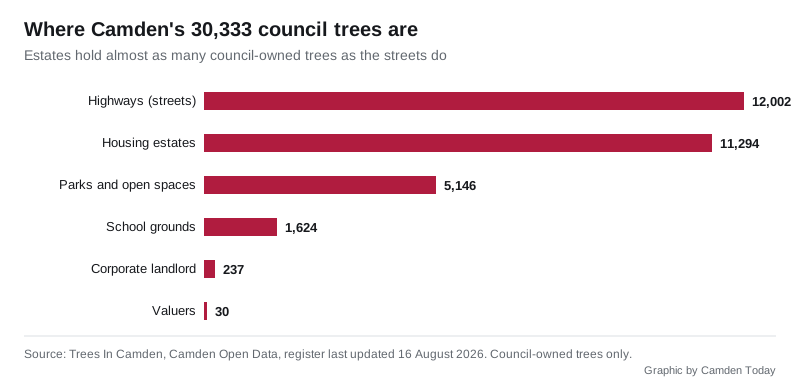
Most people picture street trees. Street trees are only 40 per cent of it.
| Managed by | Trees |
|---|---|
| Highways (street trees) | 12,002 |
| Housing (estates) | 11,294 |
| Parks and open spaces | 5,146 |
| Education (school grounds) | 1,624 |
| Corporate landlord | 237 |
| Valuers | 30 |
The housing figure is the one worth sitting with. Camden’s estates hold almost as many council trees as its streets do, which means estate residents have a direct stake in a budget most people associate with pavements.
By species, the borough is a plane tree borough and then some. London plane comes to 3,310 trees, ahead of common lime (1,778), sycamore (1,356), common ash (1,004) and silver birch (872). Planes are 12 per cent of the trees and £176.9 million of the £1 billion, because they are the oldest and largest things standing.
Thirty-six trees are classed as veteran, the category for genuinely ancient specimens. Between them they are valued at £2.46 million.
172 trees are marked to come down
The register flags every tree its officers have scheduled for removal, with the reason. Right now that is 172 trees, and the reasons are mostly not controversial:
- Dead or dying: 101
- Unsuitable location: 22
- Basal decay: 17
- Trunk decay: 10
- Root plate lifting: 5
- Crown die-back: 3
The remainder are one and two tree cases including split trunks, poor structure, a vehicle strike and an emergency root failure.
Separately, 214 records are logged in dead or dying condition and 463 in poor condition, against 15,753 good and 10,705 fair. On maturity, 10,265 records are mature, 8,935 semi-mature and 7,199 young.
The replacement trees, and the ones that do not make it
Camden tracks young trees through their first three years, which is when a newly planted street tree either establishes or dies of thirst. The register currently holds 653 first-year, 646 second-year and 567 third-year trees, so 1,866 young trees are inside the aftercare window.
It also records the ones that failed: 17 in their first year, 44 in their second and 32 in their third, 93 in total. That is the number the new contract is really aimed at, because aftercare, not planting, is where urban trees are usually lost.
How the Carbon Heroes contract works
Under the arrangement, a company bidding for a Camden contract can choose to direct its social value commitment, the community benefit suppliers are scored on during procurement, into one of three things: new tree planting, young tree aftercare, or mature tree welfare.
Carbon Heroes then puts a pound figure on the social, environmental and economic value of each commitment. Camden does the planting and the maintenance, and logs every tree with its species, location, planting date, condition and the contribution behind it.
Councillor James Slater, Camden’s cabinet member for planning and a sustainable Camden, said the council was “aligning the social value commitments suppliers make in our procurement” with its climate plan, and that the result would be “more trees being planted, and lasting benefits for residents, at no extra cost”.
He said the money would help Camden reach its aim of lifting tree canopy cover in the borough to over 26 per cent by 2045. The council’s own announcement also reports that between 2017 and 2023 its tree numbers rose from 25,890 to 28,461, carbon storage from 10,800 to 13,600 tonnes, and annual carbon sequestration from 207 to 231 tonnes.
Those figures and the register’s are compiled differently and should not be read against each other. The register is the live operational database Camden’s tree officers update on a cyclical inspection round, and by its own description it covers council-owned trees on highways and in parks and open spaces. Trees in private gardens, on Hampstead Heath and on land the council does not own are not in it.
What it means for you
- You can look up your own street. The Trees In Camden dataset is free and searchable by site name, and gives species, height, condition, inspection date and valuation for each tree.
- If a tree near you is coming down, the reason is published. Filter the same dataset on “tree set to be removed” and it names the fault, from basal decay to a vehicle strike. It is worth checking before assuming a felling is a cut.
- Trees are also a live planning matter. Of the 131 planning applications Camden registered in the seven working days to 14 August, 60 were about trees: 46 notifications of intended works in a conservation area, nine applications for work to protected trees and five emergency notifications for dead or dangerous trees. Anyone can comment on those, and our Camden planning page sets out how the process works.
- The contract costs the council nothing directly. It reroutes money suppliers were already obliged to commit during procurement, so the test of it will be how many trees actually appear, and the register is where that will show up.
Sources
- Camden Council, “Camden to use social value investment to plant more trees in the borough”, 11 August 2026
- Trees In Camden, Camden Open Data, figures pulled 17 August 2026 from a register last updated 16 August 2026
- Planning Applications Current, Camden Open Data for the weekly application counts
Have your say